

At a party or in a garden, it’s crucial to make an entrance. You’ll need charisma and, of course, the right shoes for a party. All you need for a garden is an arbor, preferably covered in magnificent climbing roses.
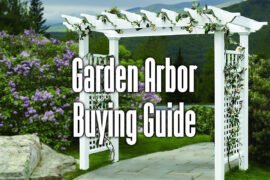
An arbor is a structure made of hardscape that transforms a dull garden into a beautiful one, framing a gateway or walkway with flowers and leaves. Arbors have been used in landscape design for millennia, dating back to ancient Greece, China, France, Portugal, Italy, India, Japan, and medieval England.
Arbors provide an enticing glimpse of the private space they’re about to enter, extending the view beyond the garden. (A glimpse is more intriguing than a complete view because it encourages you to envision what lies beyond the vines.)
Which arbor is the best fit for your yard? It is dependent on the goal you want to achieve: Arbors can be used with a gate or alone as a doorless aperture. Here is everything you need to learn about choosing the finest arbor.
What’s the distinction between a Pergola and an Arbor?
Arbors are often mistaken for pergolas and trellises. What exactly is the distinction? Aren’t they all types of hardscaping that support plants? Yes, but each one plays a distinct role in the landscape.
A pergola may be used to support a rooftop grid, allowing vines to be trained for natural shade production. It’s the size of a room, and it may be standalone or connected to home to cover a patio. A trellis is a grid that stands upright against a wall or fence to support trailing greenery. An arbor is a standalone structure that serves as a gateway to your garden by providing an avenue of living plants for you to walk through.
Take a look at it this way. The pergola would be the ceiling of your garden if it were a room. The wall would be the trellis. The arbor would serve as a gateway. On this page, we’ll go through some essential elements to consider when selecting an arbor for your garden.
Should I choose an Arbor that is beautiful or one that puts in a lot of effort?
You need both. The form should always follow function, as any designer would tell you. The arbor is lovely because it gives plants a spine to grow on, such as climbing, rambling, and twining flowers, fruits, and veggies. Arbors are more than a place to store wisteria and climbing roses on the ground. They add a vertical zing to the flat, monotonous ho-hum of a yard or garden. The combination of forms is a design concept known as contrast, which prevents your garden from being static. They also attract a person’s attention upward, making the surrounding garden seem larger and more magnificent.
How do I pick the ideal arbor size, scale, and style for my yard?
Choose an arbor that complements the architectural style of your home. A cottage-style arbor would look as misplaced next to a midcentury modern house as boho fringe on a Burberry coat. Make sure your arbor is at least six feet tall and three feet wide since you’ll be able to walk through it. The arbor also needs to be proportionate with its surroundings. Arbors come in various widths, ranging from three to ten feet. A three-foot-wide arbor is sufficient for most home gardens, but you’ll need a huge garden to fit an arbor that’s the length of a smart car. Make sure it’s made of weatherproof materials that can stand up to the elements and is solid enough to hold the weight of climbing plants. A garden catastrophe occurs when an arbor collapses in two seasons or with the weight of a wisteria.
Is it feasible for me to build an arbor?
Yes, you may build an arbor to match your home if you have the necessary skills. If you prefer to watch HGTV overbuild weekend furniture, you can purchase kits that may be built with only time and a screwdriver. You may also find arbors that are ready to install and don’t require any technical expertise or equipment.
What are the most effective arbor materials?
Arbors constructed of iron, steel, wood, and wood polymer composite materials can endure the elements and wear and tear. The most traditional designs are arbors made of wood or metal. Choose a weather-resistant wood like cedar that is resistant to decay and insects or a powder-coated metal that can rust for a long-lasting arbor.
What are the most popular arbor styles?
Continue reading to learn about arched, moon gate, gabled, and bench-equipped arbors and select the best one for your garden.
Arched Arbors
The arched arbor is a traditional design that you’ll see most of the time. It’s generally constructed of wood or metal. It has two flat sides that form a graceful arch when they meet above. Grid or ladder-rung supports are used in arched arbors to enable plants to climb up. Plant it sparsely so that its wisps and edges may be seen through the foliage if you want your arbor to be beautiful and visible. If you want the plants to steal the show, make sure they completely cover the arbor in a blanket of greenery.
Best plants for an arched arbor: Climbing plants such as passionflower, clematis, and jasmine may be twined together. A climbing nasturtium or coral honeysuckle will create a floral entryway by racing up an arbor. Train your climbing rose to grow up the arbor so that you may pass through a fragrant rose garden when you enter your yard.
Moon Gate Arbors
The Moon Gate Arbors are half-moon arbors that appear to be three-quarter moons. They’re bigger than other arbors, ranging from six to eight feet in diameter; thus, they’re ideal for big yards. They’re generally constructed of metal and feature ladder-like slats for vines to cling to. The harsh simplicity of these contemporary minimalist sculptures would look ideally at home in a modern or Asian-style garden, taking the lead role as sculpture instead of the supporting one as plant support. Moon arbors are based on moon gates, which were first used in ancient China as garden wall decorations to portray a moon rising above the earth. The Moon gates were symbols of birth and regeneration for the Chinese and a symbol of the endless cycle of life. Moon gate arbors are a beautiful doorway between the outside world and your garden, bringing Zen cool to your space as an element.
The best plants for a moon gate arbor are: Vines that aren’t woody, such as clematis and sweet pea, which will shoot up the moon gate as it blooms. The moon gate arbor is transformed into a modern sculpture in the winter using an annual vine.
Design tip: At your garden’s entrance, create a tunnel of plants by planting three to five moons gate arbors three to five feet apart and preparing plants to climb up each one and fill the space between them. You can also train an evergreen rambling plant on them, and you’ll have a tunnel of green all year long.
Grape Arbors
A flat-top was added to grape arbors in order for them to better support the fruit and woody vines of grapes. They’re useful if you don’t want a backyard vineyard since they can tolerate a wide range of plants with heavy vines and fast growth. The majority of grape arbors are constructed of wood and include beams across the top that mimic the profile of a pergola.
The best plants for a grape arbor are: Grapes, of course. The whopper plant Wisteria grows into is the trumpet vine.
Gabled Arbors
Gabled arbors resemble children’s drawings of triangular house roofs with steep, pitched tops. They’re usually constructed of wood and are a constant in English gardens: crisp, angular, and correct. You should generally allow the pointed roofs to show through the plants to give this garden fixture an architectural feel. Wood is the most common material.
The best plants for a gabled arbor are: Climbing roses (English) are the ideal choice because they grow slowly enough to prevent their stems from covering the arbor’s roofline. Climbing vines include clematis, hummingbird vine, and black-eyed Susan vine.
Design tip: Trim the vines, so they cover the roof without hiding its angles.
Arbors with a Bench
Not all arbors may be utilized as a doorway. Some come with a built-in seat so you can set the arbor in your garden and create a shaded nook where you may relax and admire your plants. It’s like a little pergola. Bench arbors usually include three sides of a grid for plant support, two on each side and one behind the bench, giving the impression of sitting in a semi-private tree grove.
Best plants for a bench arbor: To shield the backyard beyond, choose climbers that will build a thick wall of green. Wisteria and grapes are also excellent options. English ivy will quickly cover your arbor in green. Your bench arbor can be a fragrant bower with scented climbers such as jasmine, honeysuckle, or roses.
Design tip: Place a bench arbor in your garden’s corner with a pathway that leads to it, making it a destination.


3 Comments
Pingback: Gorgeous Garden Arbor Ideas for an Enchanting Outdoor Space
Pingback: 7 Places to get Free Arbor Day Trees - Discover the yard
Pingback: What’s the Difference Trellises, Arbors, and Pergolas - Discover the yard